Finding Radon Gas in my home and how I remediated it
First, what is Radon Gas?
Radon is a naturally occurring, radioactive gas produced by the breakdown of uranium in soil, rock, and water. It is invisible, odorless, and tasteless. As a leading cause of lung cancer, it poses a health risk when it accumulates inside homes, schools, and workplaces after seeping through foundation cracks or gaps.
Health Canada information: https://www.canada.ca/en/health-canada/services/environmental-workplace-health/reports-publications/radiation/radon-your-home-health-canada-2009.html
Map of Radon in Canada: https://health-infobase.canada.ca/datalab/radon-blog.html
I had first heard about it over 10 years ago when it was mentioned on CBC Radio and that test kits were available and actively promoted in Nova Scotia since we have areas with high levels. Back then, I proceeded with a one-time long-term test that you place in your home and then send to a lab after 90 days. When the results came back, the levels were high at 906 Bq/m3. I sealed a few gaps in my basement around pipes in the foundation and increased air exchange on my HRV, but did not take it too seriously after that.
Now in 2026, I recently heard more news about how it was identified as a leading cause of lung cancer and the story of a doctor in B.C. who experienced this first hand. This got me thinking more seriously about it again.
Article Link: https://www.cbc.ca/news/health/radon-home-mitigation-9.7063662
I did some research and purchased a digital radon meter which makes it much easier to do multiple tests when checking various places in your home. This avoids the repeated cost and delays of the lab testing method. The unit I settled on was the AIRTHINGS Corentium Home, available from Amazon or Home Depot.
Link to Radon Meter: https://www.amazon.ca/dp/B00H30TLPA
The results I found were concerning.

Readings in the basement where I work all day were over 600 Bq/m3 and over 400 Bq/m3 throughout the rest of the home, even on upper floors. I assumed Radon only stayed in the basement (since it’s heavier than air) however I found this not to be the case. The safe level is considered to be below 200 Bq/m3 by Canadian standards. Note that the US uses different units to measure Radon, their safe level is 4 pCi/L – keep that in mind if you are doing your own research.
Also an excellent source: https://www.lung.ca/radon
My family wanted to act immediately to remediate this. I found that there were limited options locally and it was difficult to find a radon remediation professional who would respond. I did manage to reach one in Halifax and they were not able to come for just one small job in the middle of winter, and in the end, suggested that I just try to remediate it myself! Challenge accepted. After watching some of the many YouTube videos online, I decided to take it on.
Quote from my family: “I should have just been smoking a pack a day, why didn’t you tell me sooner?“
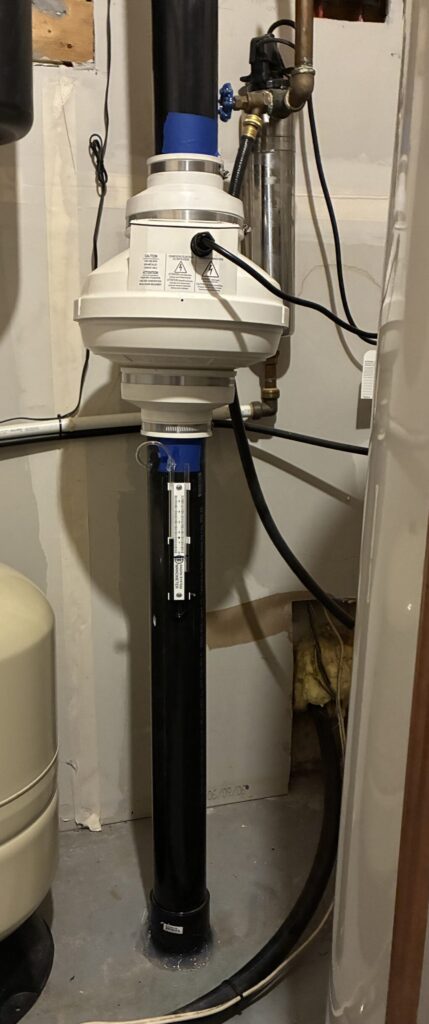
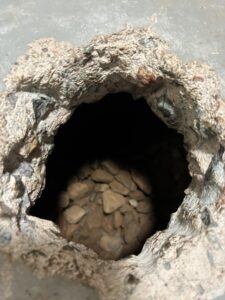
The radon fan was installed in a utility room in the basement. In the US, the fan is more typically located outside or in the attic, venting above the roofline. I found that in Canada, the fan can be located inside also with venting outside through the wall. This made the installation easier for me and allowed the fan to be plugged into a nearby outlet. A hole in the concrete floor was made about 12″ away from the foundation wall to clear any footers, it was done with a simple hammer drill to create a hole about 4 in. diameter. About 3 buckets of gravel was removed with a shop-vac to increase surface area.
Aside from the radon fan which was purchased from Amazon, the rest was just standard 3 in. drain line parts and some sealants from Home Depot. They key is – develop a negative pressure under the slab so the radon just naturally wants to leave through the fan, it does not enter the home. Sealing any obvious holes and cracks is an important part as well.
Link to Radon Fan: https://www.amazon.ca/dp/B0B72BPGTS
The total cost was under $1000, one day of preparation and one solid day of installation (I was ballpark quoted 5X that to have it done).
The noise is minimal and power consumption is around 100W, though smaller models are available. I did not want to take a chance with a smaller size because of the unusual layout of our foundation walls and connection to the garage slab. I was surprised that location isn’t as critical (it doesn’t have to be in the middle of your house).
Professional installation is recommended, however, here is proof that it can be a DIY project.

The following video clip shows the radon fan in action and where it exits the house just above the foundation wall.
Finally, the exhaust pipe vents away from any openings in the home.
Be sure to check for any local regulations to ensure your installation follows standard practices.
After all, I did find another resource that could help find a professional for those who need to find a contractor to remediate.
Link to certified installers: https://c-nrpp.ca/find-a-professional/
Will update later with any further news, but at the moment we can hopefully sleep a wee bit better at night.
Posted Mar 31, 2026